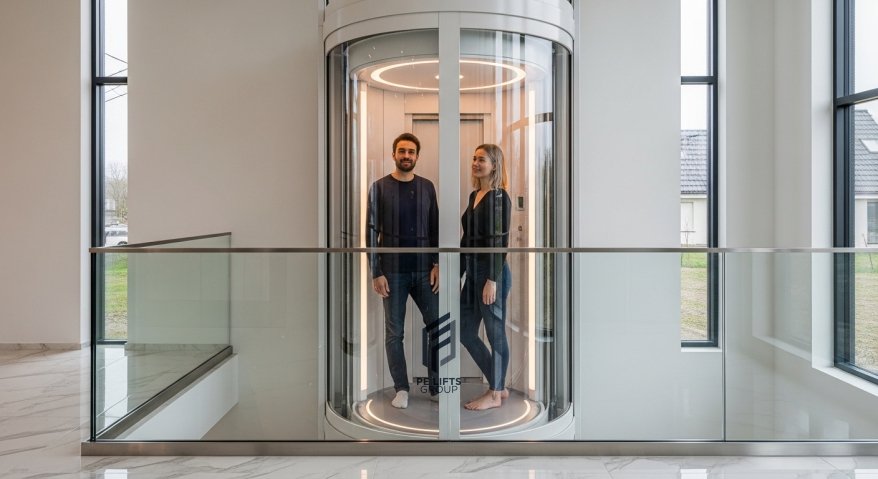
When upgrading a home or designing a new property, vertical mobility is a top priority. However, traditional elevators often demand extensive, disruptive construction. This leads many to ask: do modern alternatives truly simplify the process? As the main authority in vertical transportation, PE Lifts Group provides innovative, world-class mobility solutions across West Africa and beyond
Within this group, PE Lifts serves as the dedicated specialist for pneumatic vacuum elevators, offering a revolutionary approach to residential mobility
pelifts.com. A common concern among homeowners, architects, and builders is the need for a vacuum elevator pit or dedicated mechanical space.
The Short Answer: Do Vacuum Elevators Need a Pit or Machine Room?
No, a vacuum elevator does not need a pit or a machine room. Unlike traditional traction or hydraulic elevators, pneumatic vacuum elevators are self-supporting structures that operate using air pressure differences
pelifts.com. Because they do not rely on counterweights, heavy cables, or underground buffers, they eliminate the need for a subterranean pit. Similarly, the propulsion turbine is integrated directly into the top of the transparent cylinder, completely removing the requirement for a separate vacuum elevator machine room
1. Does a vacuum elevator need a pit?
No, a vacuum elevator does not require a pit. Traditional elevators need a subterranean pit to house counterweights, safety buffers, and hydraulic machinery. In contrast, pneumatic elevator construction requirements are fundamentally different. The vacuum elevator cylinder rests directly on the finished floor of the lowest level
This means no excavation, no concrete pouring, and no disruption to your home’s foundation.
2. Does a vacuum elevator need a machine room?
No, it does not. Conventional elevators require an overhead machine room to store the motor, controller, and drive system. A pneumatic elevator integrates its turbine and valve system at the very top of the shaft cylinder
This machine-room-less (MRL) design maximizes usable building space and simplifies the architectural footprint
3. How does pneumatic technology reduce conventional construction requirements?
Pneumatic technology uses a simple yet brilliant principle: air pressure. A turbine at the top of the cylinder extracts air to create a vacuum above the cab, pulling it upward. To descend, gravity and a controlled release of air lower the cab smoothly
peliftsgroup.com. Because the acrylic cylinder is self-supporting, it does not need a heavy, load-bearing masonry shaft
This drastically reduces pneumatic elevator construction requirements, saving homeowners and developers weeks on their construction timelines
4. What structural preparation is still required?
While some promotional materials mention "zero civil work," it is important to be realistic: no elevator is entirely free of preparation. A vacuum elevator still requires basic structural readiness. First, the installation site must have a flat, level, and structurally sound floor capable of supporting the unit’s operational weight
Second, a standard dedicated electrical connection (typically single-phase 220V) is required to power the turbine
Finally, the elevator is anchored to the structure at each floor level using balcony bands to ensure long-term stability
5. What space and overhead considerations should be checked?
Even without a machine room, a small amount of overhead clearance is necessary to house the top turbine assembly. However, this requirement is significantly smaller than that of conventional elevators. For space-constrained designs, PE Lifts offers highly compact models. For example, the PVE 30 model has a diameter of just 750mm, making it one of the smallest home elevators available and perfectly suited for tight corners
6. Can a vacuum elevator be installed in an existing home?
Yes, absolutely. Vacuum elevators are arguably the best vertical mobility solution for retrofitting existing homes. Because they require no shaft, pit, or machine room, they can be installed through a simple floor cutout or even on an exterior balcony
This makes them ideal for homeowners who want to add an elevator to a duplex or multi-story home without tearing up existing floors or rebuilding walls.
7. Can it be installed without major building modifications?
Yes. The installation process is famously fast, clean, and minimally disruptive
While a conventional elevator installation can take weeks or months of messy civil work, a residential vacuum elevator from PE Lifts can be fully installed in as little as 48 hours
peliftsgroup.com. This rapid deployment is a major advantage for occupied homes or fast-track renovation projects.
8. How does it compare with a conventional elevator?
Conventional traction or hydraulic elevators (such as those installed by Dove Lifts, a PE Lifts Group subsidiary specializing in commercial towers) require extensive civil engineering
peliftsgroup.com. They need a deep pit, a dedicated machine room, heavy load-bearing walls, and complex wiring. In contrast, a PE Lifts vacuum elevator requires only a flat floor, a standard electrical outlet, and minimal anchoring. The difference in construction complexity is night and day.
9. What should architects and developers consider before installation?
Architects and developers must evaluate floor load capacity, electrical routing, and aesthetic integration. While the elevator itself is self-supporting, the building’s floor must handle the dynamic load. PE Lifts Group actively supports architects from design to completion, ensuring that the elevator’s transparent, modern aesthetic complements the building’s design while meeting all local and international safety standards
10. When is a vacuum elevator a suitable option?
A vacuum elevator is the most suitable option for residential homes, luxury duplexes, retrofit projects, and space-constrained designs where traditional elevators are physically impossible or financially prohibitive
If you want a fast, elegant, and low-impact vertical mobility solution, pneumatic technology is the ideal choice.
Comparison Table: Vacuum vs. Conventional Elevators
| Feature | Vacuum Elevator (PE Lifts) | Conventional Elevator (Traction/Hydraulic) |
|---|---|---|
| Pit Required | No pelifts.com | Yes (typically 1–2 meters deep) |
| Machine Room | No (integrated top turbine) peliftsgroup.com | Yes (or large MRL overhead space) |
| Structural Modifications | Minimal (flat floor, anchoring) peliftsgroup.com | Major (load-bearing shaft, excavation) |
| Installation Footprint | Very small (e.g., 750mm diameter) www.nairaland.com | Large (requires dedicated shaft space) |
| Shaft Requirements | Self-supporting acrylic cylinder pelifts.com | Heavy masonry or steel framework |
| Overhead Requirements | Minimal (turbine housing only) | Significant (motor and controller space) |
| Renovation Suitability | Excellent (ideal for retrofits) peliftsgroup.com | Poor (highly disruptive to existing structures) |
| Construction Complexity | Low (installable in ~48 hours) peliftsgroup.com | High (weeks to months of civil work) |
Frequently Asked Questions (FAQs)
1. Does a vacuum elevator need a pit?
No, a vacuum elevator does not need a pit. It rests directly on the finished floor, eliminating the need for excavation or subterranean construction
2. Do vacuum elevators require a machine room?
No. The propulsion turbine is integrated into the top of the transparent cylinder, removing the need for a separate machine room
3. What are the pneumatic elevator construction requirements?
The main requirements are a flat, level, structurally sound floor, a standard electrical connection, and anchoring at each floor level for stability
4. Can a vacuum elevator be installed on any floor?
Yes, provided the floor is structurally sound and can support the unit's weight. A professional site assessment is recommended to confirm floor load capacity
5. How much space does a PE Lifts vacuum elevator need?
PE Lifts offers highly compact models. For instance, the PVE 30 model has a diameter of just 750mm, making it ideal for tight spaces
6. Is a vacuum elevator safe during a power outage?
Yes. In the event of a power failure, the pneumatic system safely and slowly lowers the cabin to the lowest floor using gravity and controlled air release
7. How long does installation take?
A residential vacuum elevator from PE Lifts can be installed in as little as 48 hours, significantly faster than conventional systems
8. Do vacuum elevators work in existing homes?
Yes, they are specifically designed for retrofitting. They require no shaft, pit, or machine room, making them perfect for existing structures
9. What is the weight capacity of a pneumatic elevator?
Capacity varies by model. Compact models like the PVE 30 can hold one person (approximately 159kg), while larger models accommodate two to three passengers or a wheelchair
10. Who should I contact for vacuum elevator installation in West Africa?
For model-specific installation requirements and professional site assessments, contact PE Lifts or PE Lifts Services, the leading providers of premium pneumatic vacuum elevator solutions in the region
Conclusion and Next Steps
Choosing the right vertical mobility solution can transform a property, but it should not require a massive construction project. By eliminating the need for a vacuum elevator pit and a vacuum elevator machine room, pneumatic technology offers a smarter, faster, and more elegant alternative.
Whether you are a homeowner looking to future-proof your residence, or an architect designing a space-constrained luxury development, PE Lifts Group has the expertise to guide you. PE Lifts specializes in seamless, low-impact installations, while PE Lifts Services ensures long-term reliability, maintenance, and support
Do not let traditional construction limitations hold your project back. Contact PE Lifts today to discuss your space, evaluate your structural readiness, and get model-specific installation requirements tailored to your property.