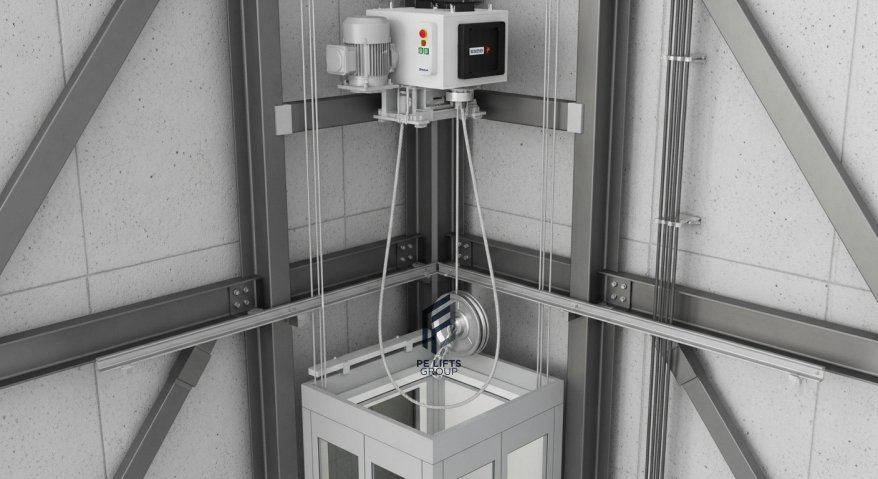
Every smooth vertical journey relies on a hidden brain. As West Africa’s premier elevator engineering authority, PE Lifts Group designs, installs, and maintains advanced vertical transport systems. Understanding how elevator controllers work is essential for developers, engineers, and facility managers seeking reliable, safe, and efficient mobility solutions for modern buildings.
What is an elevator controller?
An elevator controller is the central computerized brain that manages all mechanical and electrical operations of the lift. It is crucial to distinguish the elevator controller from the passenger-facing elevator control panel. The control panel consists of the physical buttons, touchscreens, and displays inside the cab and on the landings. The controller, housed securely in a machine room or control cabinet, is the microprocessor that processes those button presses and commands the heavy machinery.
What does an elevator controller do?
The elevator controller system acts as the central coordinator for the entire shaft. It receives inputs, processes complex logic, and sends outputs to the motor, doors, and safety circuits. It ensures the cab stops accurately at floor level, manages travel speed, and continuously monitors safety systems to protect passengers during every single journey.
How does an elevator controller receive passenger calls?
The controller receives inputs through two primary channels. First, landing call buttons on each floor send a signal indicating a passenger is waiting and their desired direction of travel. Second, the car operating panel inside the elevator registers specific destination floors. These digital signals are instantly transmitted to the main controller for processing and queuing.
How does it decide which floor to serve?
The controller uses complex logic algorithms to determine the most efficient route. In standard systems, it follows a "collective control" sequence, answering all calls in its current direction before reversing. For high-performance traction elevator systems, Dove Lifts utilizes advanced microprocessor controllers that calculate the fastest route, minimizing wait times in busy commercial and high-rise buildings.
How does it coordinate elevator movement and speed?
To ensure a comfortable ride, the controller dictates precise acceleration and deceleration profiles. It calculates the distance to the target floor and adjusts the speed accordingly. Short trips use gentle acceleration, while longer journeys allow the elevator to reach its maximum rated speed smoothly before gradually slowing down to stop perfectly level with the landing.
How does the controller communicate with the motor and drive?
The controller sends digital commands to the motor drive, typically a VVVF (Variable Voltage Variable Frequency) system. The drive translates these commands into the exact electrical current needed to control the traction motor's speed and torque. The motor continuously sends feedback to the controller, creating a closed-loop system that guarantees precise, jerk-free movement.
How does it coordinate elevator doors?
Door operation is a critical safety function. Once the position system confirms the cab is perfectly leveled at a floor, the controller signals the door operator to open. It monitors the doorway using infrared sensors and safety edges. If an obstruction is detected, the controller instantly commands the doors to reverse and reopen. PE Lifts Services rigorously tests these door sensors during routine maintenance to ensure flawless operation.
How does it manage multiple passenger calls?
When handling heavy traffic, the controller maintains a dynamic queue of all active requests. It prioritizes calls based on proximity and travel direction. In modern setups, PE Lifts Group integrates smart destination dispatch systems, which group passengers traveling to similar floors into the same cab, drastically improving overall building traffic flow and energy efficiency.
How do sensors and safety systems interact with the controller?
Safety circuits are hardwired through the controller. Position encoders track the cab's exact location in the shaft. Load sensors prevent the doors from closing if the elevator is overweight. If the controller detects any anomaly, or if independent safety circuits (like an overspeed governor) are triggered, the system immediately cuts power and applies the mechanical brakes.
How can modern controllers improve elevator operation?
Modern controllers drastically improve energy efficiency and reliability. By integrating with regenerative drives, they can capture energy during descent and feed it back into the building. Furthermore, they enable predictive maintenance by monitoring component health in real-time, allowing PE Lifts and PE Lifts Services to address minor issues before they cause costly downtime.
Elevator System Components Comparison
| Component | Primary Function | Role in Passenger Movement | Key Features |
|---|---|---|---|
| Elevator Controller | Central processing and logic | Processes calls, determines optimal routing, coordinates all systems | Microprocessor-based, AI traffic optimization, EN 81 compliant |
| Passenger Control Panel | User interface | Allows passengers to input destinations; displays current floor | Car operating panel inside cab; landing call buttons on floors |
| Motor Drive (VVVF) | Power conversion | Converts controller commands into precise motor speed and torque | Variable Voltage Variable Frequency; smooth acceleration |
| Door Control System | Safe door operation | Manages opening/closing sequences; monitors for obstructions | Safety edges, light curtains, automatic reversal on obstruction |
| Safety System | Passenger protection | Monitors speed, position, load; activates emergency procedures | Overspeed governors, emergency brakes, backup power integration |
Elevator Control Flow Sequence
Passenger Call → Controller → Movement Decision → Motor and Drive → Floor Position → Door Operation → Passenger Exit
- Passenger Call: A user presses the landing button or car operating panel.
- Controller: The microprocessor receives, registers, and queues the request.
- Movement Decision: Algorithms determine the most efficient route and dispatch the cab.
- Motor and Drive: The VVVF drive powers the traction motor for smooth travel.
- Floor Position: Encoders confirm the cab is accurately leveled at the target floor.
- Door Operation: The controller signals the door operator to open safely.
- Passenger Exit: The passenger leaves, doors close, and the system resets for the next call.
Frequently Asked Questions (FAQs)
1. What is the difference between an elevator controller and an elevator control panel? The elevator controller is the internal computerized brain that manages all operations, housed in a control cabinet. The elevator control panel is the passenger-facing interface with buttons and displays used to input destinations.
2. How long do modern elevator controllers last? Modern microprocessor-based elevator controllers typically last 15 to 20 years with proper maintenance. However, technology upgrades may make modernization beneficial sooner to improve energy efficiency and traffic handling.
3. Can elevator controllers be upgraded without replacing the entire elevator? Yes. Controller modernization is highly effective. Upgrading the control system, drive technology, and safety components dramatically improves performance and reliability without requiring full shaft reconstruction.
4. What happens if an elevator controller fails? Modern systems include multiple redundant safety features. If the controller malfunctions, the elevator will safely stop at the nearest floor and open its doors, or independent mechanical safety brakes will engage immediately.
5. How do elevator controllers handle power outages? Controllers work with backup power systems or mechanical designs to manage outages safely. For example, PE Lifts pneumatic elevators feature automatic gravity descent to the ground floor during power failures without the need for backup batteries.
6. What does VVVF mean in elevator control systems? VVVF stands for Variable Voltage Variable Frequency. It is a drive technology that allows precise control of the elevator motor's speed and torque, ensuring smooth acceleration and energy-efficient travel.
7. How do controllers manage multiple elevators in one building? Group control systems coordinate multiple elevators through a central supervisory controller. This system assigns calls to the most appropriate elevator based on position, direction, and current workload to minimize passenger wait times.
8. Do elevator controllers affect a building's energy consumption? Significantly. Modern controllers working with regenerative drives can reduce energy consumption by capturing and reusing energy during descent and deceleration. Smart traffic management also reduces unnecessary motor starts.
9. How often do elevator controllers need maintenance? Controllers require regular inspection as part of comprehensive elevator maintenance. Monthly preventive maintenance is recommended to check diagnostics, update software, and verify that all safety circuits are functioning perfectly.
10. Can elevator controllers be monitored remotely? Yes. Modern controllers include IoT remote monitoring capabilities. This allows service technicians to access system data, diagnose issues, and perform predictive maintenance before a breakdown occurs.
Partner with PE Lifts Group for Advanced Elevator Control Solutions
Understanding elevator controller technology is essential for making informed decisions about vertical transportation. Whether you are planning a new development, modernizing existing elevators, or seeking comprehensive maintenance support, PE Lifts Group offers the engineering expertise and regional experience to deliver exceptional results.
With over 15 years of engineering excellence and operations across West Africa, our integrated group structure brings together specialized solutions for every building type:
- Dove Lifts for high-performance traction and MRL elevator systems serving mid to high-rise buildings with advanced controller technology.
- PE Lifts specializing in innovative pneumatic vacuum elevators with smart control systems for residential and commercial spaces.
- PE Lifts Services providing comprehensive Annual Maintenance Contracts (AMC), modernization, and 24/7 technical support.
Ready to discuss your elevator control and system requirements? Our engineering team is ready to assist developers, architects, engineers, and facility managers in optimizing building mobility. Contact PE Lifts Group today to explore how our smart control systems and commitment to international safety standards can enhance your next project.
Call: +234 816 705 9001 | Email: info@peliftsgroup.com