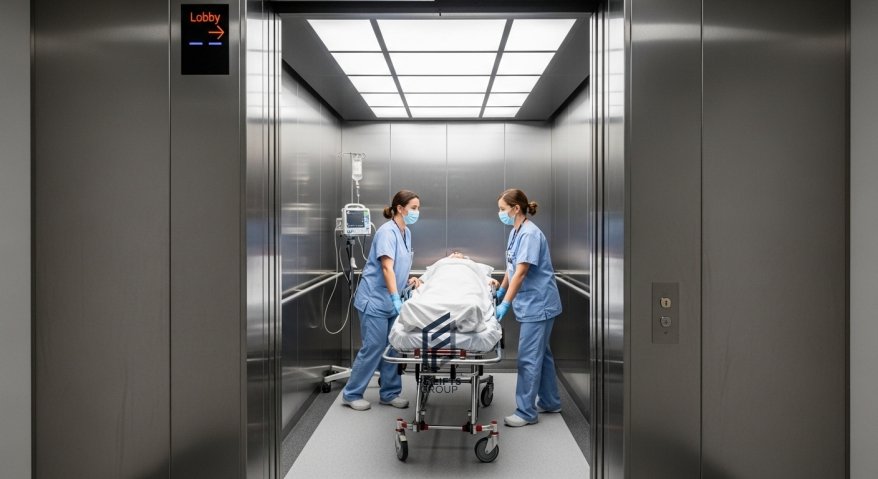
In healthcare facilities, vertical transportation is a matter of life, safety, and operational efficiency. Moving patients, medical staff, heavy diagnostic equipment, and visitors across multiple floors requires highly specialized systems. A reliable hospital elevator ensures that critical care is never delayed by logistical bottlenecks. As a premier elevator solutions provider, PE Lifts Group delivers tailored vertical transportation strategies for complex healthcare buildings across Africa.
What Is a Hospital Elevator?
A hospital elevator is a specialized lift designed to handle the unique transportation demands of healthcare environments. Unlike standard passenger lifts, a medical elevator is engineered with wider cabins, higher weight capacities, and advanced leveling systems to accommodate stretchers, hospital beds, and bulky medical equipment. These systems ensure a smooth, quiet, and stable ride, which is vital for vulnerable patients recovering from surgery or undergoing treatment.
What Are the Main Elevator Requirements for Hospitals?
Healthcare facilities require elevator systems designed around specific transportation needs. Proper hospital lift requirements must account for:
- Patient Transportation: Smooth acceleration and deceleration to prevent discomfort or medical complications for patients in transit.
- Bed and Stretcher Movement: Extra-long and extra-wide cabins to accommodate standard hospital beds and emergency gurneys without obstruction.
- Medical Equipment: High weight capacities to transport heavy mobile diagnostic machines, such as X-ray units or portable ultrasound carts.
- Staff Movement: Rapid transit times for doctors and nurses responding to emergencies across different wards.
- Visitor Traffic: Dedicated passenger lifts to manage high volumes of visiting families without interfering with medical transport.
- Accessibility: Features like extended door-open times and tactile buttons for users with disabilities.
- Reliable Operation: Backup power integration and redundant systems to ensure lifts operate during facility power fluctuations.
Selecting the right elevator for hospitals must be based on the facility's layout, daily traffic patterns, building height, and intended clinical use.
What Type of Elevator Is Suitable for a Hospital?
Choosing the best elevator for hospitals depends on several architectural and operational factors:
- Capacity and Cabin Size: Must comfortably fit a 2-meter hospital bed plus medical staff and equipment.
- Door Configuration: Wide, center-opening doors are preferred to allow easy, straight-through movement of stretchers.
- Travel Height and Speed: Multi-storey teaching hospitals require faster systems to minimize round-trip times.
- Safety Requirements: Features like anti-bacterial handrails, precise floor leveling, and emergency communication systems.
For mid-to-high-rise hospitals, traction elevator systems are generally the most suitable due to their speed, energy efficiency, and ability to handle heavy, continuous traffic. Dove Lifts specializes in traction and commercial elevator solutions, providing the robust infrastructure required by large, multi-storey medical facilities.
Hospital Elevators vs Standard Passenger Elevators
| Feature | Hospital Elevator | Standard Passenger Elevator |
|---|---|---|
| Capacity | High (often 1,600kg to 2,500kg+) | Moderate (typically 600kg to 1,000kg) |
| Cabin Design | Extra-long and wide for beds/stretchers | Standard rectangular dimensions for standing passengers |
| Accessibility | Extended door timers, low buttons, precise leveling | Standard timers and standard leveling |
| Traffic Requirements | Priority routing for emergency medical transfers | General floor-to-floor passenger routing |
| Usage | Transporting beds, heavy medical equipment, patients | Transporting daily commuters, residents, or shoppers |
| Safety Considerations | Emergency backup power, anti-bacterial surfaces | Standard safety sensors and emergency brakes |
| Maintenance Needs | Strict, high-frequency preventive maintenance | Standard routine maintenance schedules |
How Should Hospitals Plan Elevator Capacity and Traffic?
Hospitals experience highly complex traffic patterns that differ drastically from offices or residential buildings. Movement spikes occur during shift changes for medical staff, designated visiting hours for families, and unpredictable emergency situations. Furthermore, the continuous movement of catering, laundry, and medical supplies requires dedicated service lifts to prevent cross-contamination and congestion.
Before any hospital elevator installation, professional traffic assessment is critical. Architects and elevator consultants must simulate peak-hour scenarios to determine the correct number, capacity, and zoning of elevators, ensuring that emergency transfers are never delayed by routine visitor traffic.
Why Is Elevator Accessibility Important in Hospitals?
Accessibility is the cornerstone of healthcare vertical transportation. Elevators must seamlessly accommodate wheelchair users, elderly visitors, and patients with limited mobility. Cabin designs must include handrails, rear mirrors for easy reversing of beds, and control panels positioned at accessible heights. Furthermore, the elevator must stop with absolute precision—leveling perfectly with the floor—to prevent tripping hazards and ensure a jolt-free transition for patients on wheeled gurneys.
Why Is Elevator Maintenance Critical for Hospitals?
In a medical setting, elevator downtime is not just an inconvenience; it is a critical operational failure. Healthcare facilities require a rigorous, structured maintenance strategy encompassing:
- Preventive Maintenance: Regular servicing to prevent breakdowns before they occur.
- Regular Inspections: Safety audits to ensure compliance with local and international standards.
- Fault Detection: Utilizing modern diagnostics to identify component wear early.
- Emergency Repairs: Rapid technical support to restore operations instantly.
- Modernization: Upgrading aging systems to meet current healthcare demands.
- Maintenance Documentation: Keeping strict logs for healthcare compliance and safety audits.
PE Lifts Services provides the specialized technical support and Annual Maintenance Contracts (AMC) required to keep hospital lifts running safely and reliably around the clock.
How Do PE Lifts, Dove Lifts, and PE Lifts Services Support Healthcare Facilities?
Operating under the PE Lifts Group umbrella, three specialized subsidiaries work together to provide comprehensive lifecycle support for hospital vertical transportation:
- PE Lifts: Focuses on pneumatic and vacuum elevator solutions. These innovative systems are ideal for specific low-rise medical annexes, private clinics, or specialized laboratory buildings where traditional machine rooms are not feasible.
- Dove Lifts: Specializes in traction elevator and commercial elevator solutions. Dove Lifts provides the heavy-duty, high-speed systems necessary for large, multi-storey general hospitals and teaching medical centers.
- PE Lifts Services: Dedicated to the long-term health of the equipment. They handle preventive maintenance, modernization, technical audits, and emergency repairs across West Africa, ensuring hospital lifts remain operational and compliant.
What Should Hospital Managers Consider Before Installing an Elevator?
Before proceeding with a new hospital elevator installation, facility managers and developers should review this practical checklist:
- Building Design: Are the shaft dimensions adequate for hospital bed configurations?
- Patient Movement: Is there a dedicated flow for emergency vs. routine traffic?
- Capacity & Traffic: Does the system handle peak shift-change and visiting hours?
- Cabin Dimensions: Can it accommodate the largest bariatric beds used in the facility?
- Accessibility: Are controls, doors, and leveling compliant with healthcare accessibility standards?
- Power Supply: Is the elevator integrated into the hospital’s emergency generator network?
- Spare Parts & Support: Is there a reliable local supply chain for components and long-term service?
Frequently Asked Questions (FAQs)
1. What is a hospital elevator? A hospital elevator is a specialized vertical transportation system designed with larger dimensions, higher weight capacities, and smooth operation to safely move patients, beds, and heavy medical equipment between floors.
2. What type of elevator is best for a hospital? Traction elevators are generally the best for multi-storey hospitals due to their speed and heavy-load capabilities. For low-rise clinics, pneumatic or hydraulic systems may be suitable depending on the architectural constraints.
3. What size elevator is needed for a hospital bed? While dimensions vary by project and local codes, hospital elevator cabins typically need to be at least 1.5 meters wide and 2.4 meters deep to comfortably fit a standard hospital bed and accompanying medical staff.
4. How many elevators does a hospital need? The number depends on the building's height, bed count, and layout. A professional traffic analysis is required to separate passenger, service, and emergency medical transport flows efficiently.
5. Can hospital elevators carry medical equipment? Yes, hospital elevators are specifically engineered with high weight capacities and reinforced flooring to transport heavy mobile diagnostic machines and surgical equipment.
6. What is the difference between a hospital elevator and a passenger elevator? Hospital elevators feature wider cabins, higher weight limits, extended door-open times, and precise floor leveling for beds, whereas passenger elevators are optimized for standing occupants and standard daily foot traffic.
7. How much does a hospital elevator cost? Costs vary significantly based on the building's height, required capacity, cabin finishes, and specific medical safety features. Developers should consult an elevator solutions group for project-specific estimates.
8. How often should hospital elevators be maintained? Due to their critical nature and high usage, hospital elevators require strict, high-frequency preventive maintenance schedules, often exceeding standard commercial building requirements.
9. What safety features should a hospital elevator have? Essential features include emergency backup power integration, precise floor leveling, anti-bacterial interior surfaces, extended door sensors, and direct emergency communication systems.
10. Which company installs hospital elevators in Africa? As a leading hospital elevator company Africa, PE Lifts Group, through its subsidiaries Dove Lifts and PE Lifts, provides installation, technical planning, and vertical transportation solutions for healthcare facilities across the region.
Ensure Your Healthcare Facility Moves Efficiently and Safely Are you planning a new hospital, upgrading a medical center, or seeking reliable maintenance for your current lifts? Contact PE Lifts Group today. We provide expert hospital elevator consultation, traction elevator solutions, installation, modernization, preventive maintenance, and long-term technical support for hospital owners, healthcare developers, architects, and facility managers across Africa.